
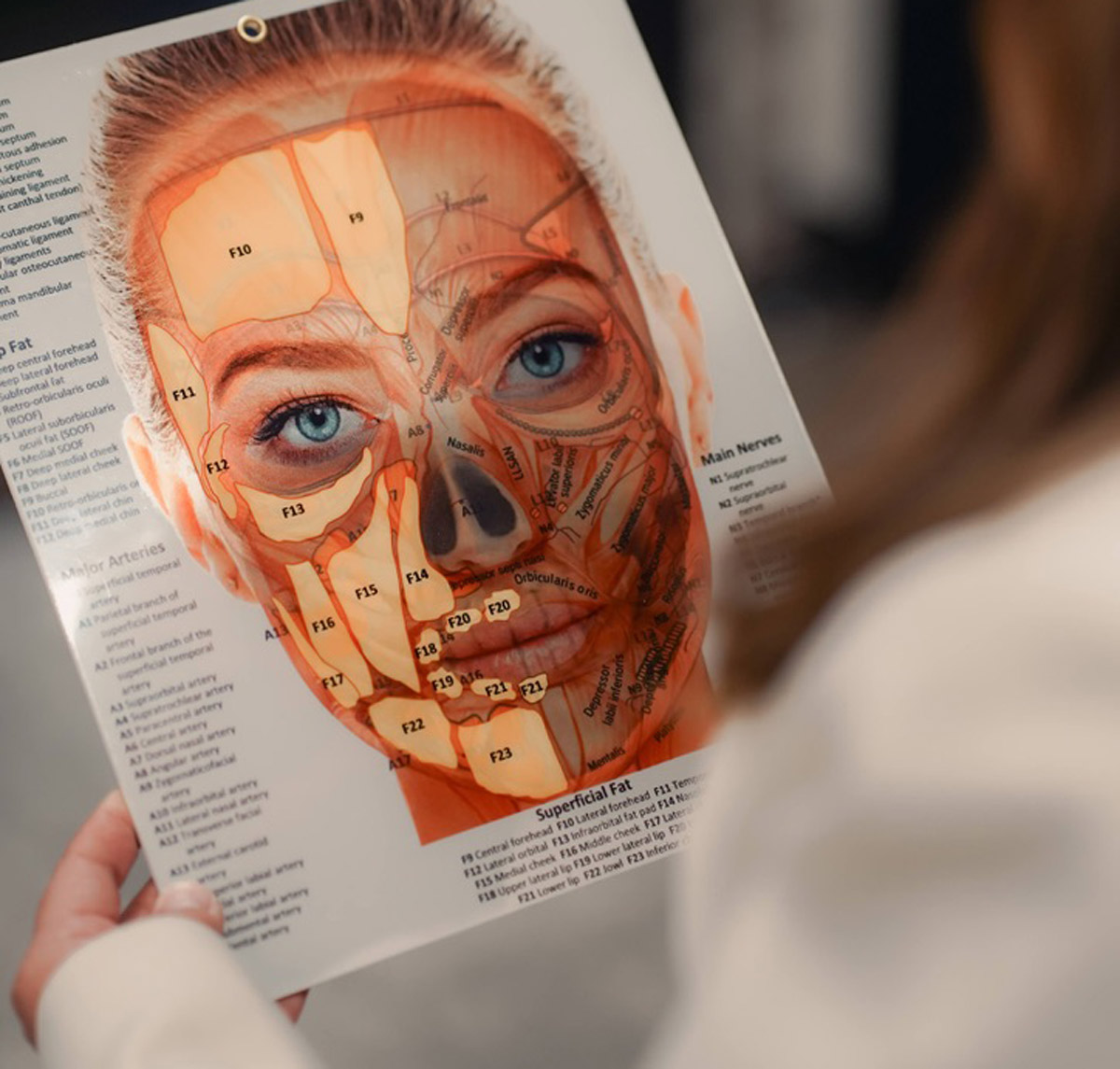
Mastering facial anatomy for injectors goes far beyond textbook memorization. While knowing where structures lie is essential, knowing how to apply that knowledge to the unique face sitting in your chair is what defines an advanced clinician.
Every responsible injector needs a strong foundation in facial anatomy. You need to understand vascular structures, tissue planes, fat compartments, facial muscles, ligaments, and the complex anatomical relationships that influence both patient safety and aesthetic outcomes.
However, as a provider gains experience, an important distinction becomes clear: knowing anatomy and knowing how to use anatomy clinically are not the same thing.
One is static knowledge. The other is dynamic clinical judgment.
Anatomy Does Not Look Identical on Every Patient
Textbooks teach anatomical structures beautifully, but real patients rarely look like simplified textbook illustrations.
Facial proportions vary dramatically between individuals. Tissue thickness changes with age, previous aesthetic treatments alter native planes, and structural changes like bone resorption impact every layer of the face. Surgical history, significant weight fluctuations, genetics, and prior procedures all shift the clinical picture.
This is why an injector cannot simply memorize where a vessel is supposed to be and assume every face will behave predictably.
Studying facial anatomy for injectors provides the core framework. Developing clinical judgment teaches you how to adapt that framework to an individual patient safely and effectively.
The Best Injectors Learn to Read the Face
Advanced facial assessment requires much more than identifying isolated structures.
As you mature as an aesthetic provider, you begin to observe how different tissue layers interact. You notice how structural support has shifted, where hyperactive muscle movement is driving surface lines, and how volume loss in one region causes sagging or asymmetry in another.
You are no longer simply asking, “What anatomy is present here?”
You are asking, “What does this specific anatomy mean for this treatment, on this patient, today?”
That shift in thinking marks the transition from a beginner to an expert injector.
Palpation, Observation, and Dynamic Movement
A patient’s face provides vital clinical data long before a needle ever touches the skin.
- What do you observe when the face is at rest?
- How do the tissue planes shift during active facial expressions?
- What structural landmarks can you identify through careful palpation?
- How dense or compliant does the soft tissue feel?
These tactile and visual observations bridge the gap between theoretical knowledge and real-time clinical decision-making.
This is precisely why hands-on training and live-patient observation are indispensable. Providers need opportunities to evaluate how anatomical concepts translate across diverse patient populations, facial shapes, and age groups rather than relying on static slides.
Judgment Means Knowing When Anatomy Changes the Plan
Sometimes your anatomical findings confirm the exact treatment protocol you initially envisioned. Other times, those findings signal that you need to pause and pivot.
Perhaps a patient’s vascular variation increases risk in a traditional injection zone. Maybe a deeper or more superficial injection plane is necessary to achieve structural lift without causing heaviness. Or perhaps the safest and most aesthetic recommendation is choosing a completely different modality.
Advanced injectors are comfortable altering their treatment plan when the patient’s anatomy demands it. That adaptability is not hesitation; it is clinical maturity.
Safety and Aesthetic Outcomes Are Deeply Connected
It is tempting to split training on facial anatomy for injectors into two separate silos: safety anatomy and aesthetic anatomy. In clinical practice, the two are inseparable.
The exact same anatomical understanding that helps you prevent vascular complications also enables you to craft superior aesthetic results. Knowing precise depth, product rheology, and tissue integration points allows you to create authentic structural lift, natural projection, and smooth contours that move seamlessly during dynamic expression.
Better anatomical understanding leads directly to better clinical decisions.
Taking the Next Step in Your Aesthetic Career
This level of education is designed for medical providers who have completed foundational training but want greater confidence when facing complex, real-world clinical scenarios.
You do not simply need another color-coded diagram. You need structured opportunities to connect what you know to live patient assessments, comprehensive treatment plans, and the strategic decision-making modeled by master clinicians.
That is where advanced clinical observation, case discussions, and ongoing mentorship become invaluable.
The Bottom Line
Facial anatomy is not a subject you memorize once and move past. It is the core language behind every safe, high-level aesthetic procedure you perform.
As your career progresses, the goal evolves from recognizing static structures to applying clinical judgment that elevates your strategy, improves safety, and delivers predictable, high-satisfaction results for every patient.
At Revive Aesthetics Academy, we teach facial anatomy for injectors as an active clinical skill rather than a passive memory exercise.
Elevate your clinical confidence. Explore our clinical foundation courses, and advanced hands-on mentorship opportunities at Revive Aesthetics Academy to master the science and judgment behind every injection.